
AI Mock Interview Simulator
STAR Telemetry & VoicePractice with dynamic AI-generated questions mapped directly to your candidate background and the target role requirements. Receive instant 10-pt rubric evaluations on each answer.

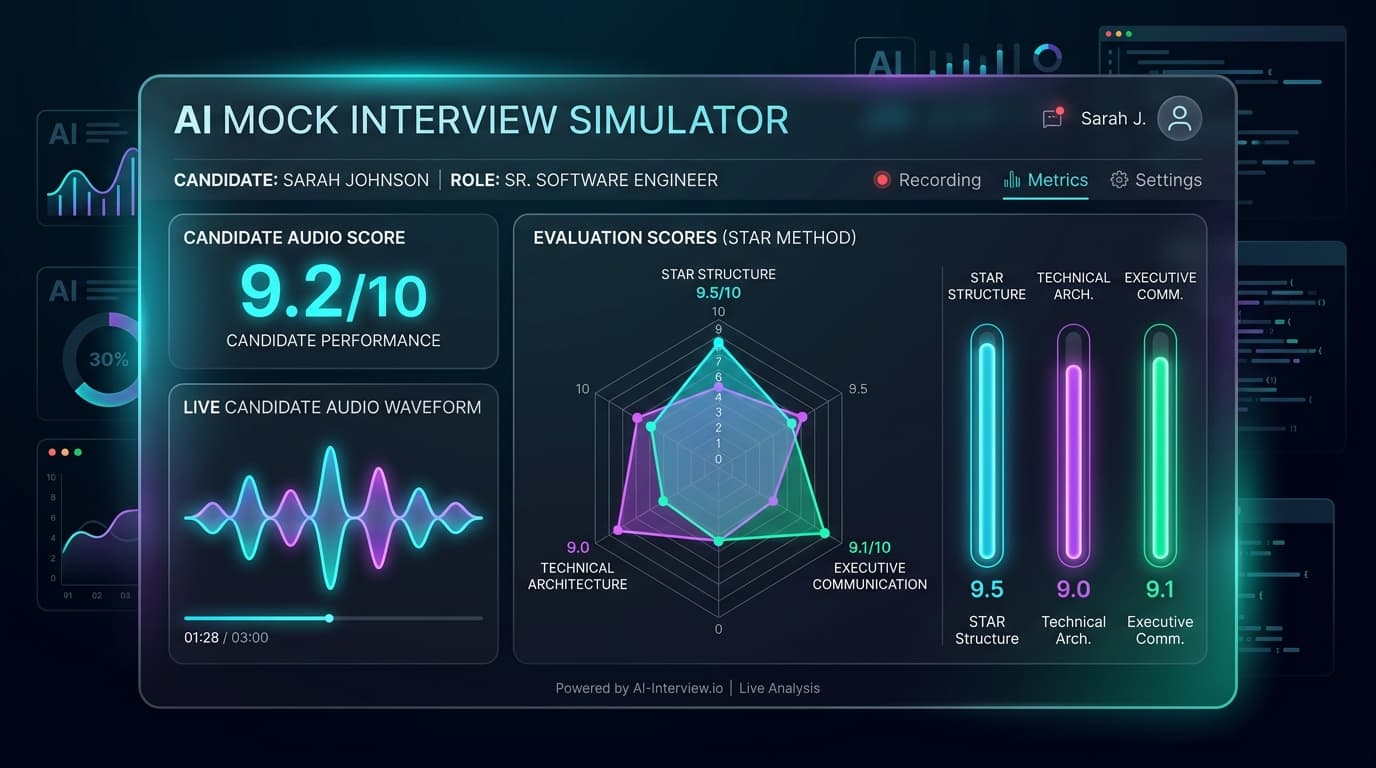
Evaluates clear framing: Situation, Task, concrete Action verbs, and quantified Business Results (%, $, latency, users).
Checks whether you articulate architecture trade-offs, bottleneck resolution, data consistency, and failure modes.
Penalizes generic conversational filler; rewards concise, high-conviction responses delivered with clarity.
Candidates who rehearse responses with the STAR rubric achieve a 3.4x higher final-round pass rate compared to unprepared applicants.
The 4 Pillars of Tier-1 Tech Interview Evaluation
STAR Method Precision & Metrics
Top engineering managers despise vague statements like “we improved reliability.” Every answer must state the exact situation, the individual task you owned, the concrete technical actions taken, and the quantified metric outcome (e.g. “cut p99 latency from 420ms to 85ms across 12M daily requests”).
Architectural Trade-Off Articulation
Senior and Staff engineers are evaluated on how they defend trade-offs: SQL vs NoSQL, synchronous REST vs event-driven Kafka, memory footprint vs throughput, and consistency vs partition tolerance under network splits. There is never a “perfect” architecture—only calibrated engineering choices.
Problem Decomposition & Think-Aloud
Interviewers grade your thought progression, not just your final architecture. Deconstruct ambiguous requirements by establishing SLA limits, calculating back-of-the-envelope RPS and storage requirements, checking edge cases, and communicating aloud before writing code.
Cross-Functional Influence & Mentorship
High-compensation tech offers require proof that you elevate team velocity. Interviewers listen for how you aligned divergent product stakeholders, conducted blameless post-mortems, authored design RFCs, and mentored junior team members through complex refactors.